Monday, 30 January 2012

The Genius of Illumination

British Library exhibitions rarely disappoint, so it was no great surprise that the latest, Royal Manuscripts: The Genius of Illumination was such an impressive tribute to the lost art of illuminating manuscripts.


I find the timing of the exhibition apt: it serves as a reminder to us e-reading, free paper-skimming Londoners of how much time and care once went into producing books. At the same time, it highlights how far we've come in democratising the written word; what was once reserved for royalty is now available readily to the masses, free or charge or at minimal cost, albeit in far less glorious forms. E-ink for the people is perhaps preferable to gold leafed texts for the very elite.

Anyway, I digress. The exhibition showcases over 150 elaborately-decorated manuscripts, primarily of a Biblical and/ or historical nature(there's a lot of overlap between the two, with religion being the main provider of historical discourse way back when). Illuminators would typically spend years - even a lifetime - on a single manuscript, adding illustrations and page borders and embellishing initial letters at the start of each chapter to create a unique masterpiece for a royal recipient. Personalising the manuscript for the owner was hugely important: illuminators commonly incorporated the former's royal coat of arms into patterns and borders.


From a contemporary point of view, the illuminations aren't just decoration. They give colour and context to our understanding of the historical periods in which they were produced (Medieval and Renaissance) - a point that the BL has emphasised: 'Together they are our most vivid source for understanding royal identity, moral and religious beliefs, learning, faith artistic trends and the international politics of the period.'

Saturday, 3 December 2011

A Clash of Cultures in Seville

Recently I was in the south of Spain - Seville, to be more precise - wandering the postcard-perfect cobbled streets, chowing down on tapas, exploring opulent - erring on the side of vulgar - Catholic churches, and observing with affection the spirited locals. As I write this, my mind drifts to thoughts of the sound of the city, consisting of the music of street performers, the clip-clop of horses' hooves and the not-so-discreet conversations and laughter of convivial Spaniards sustained day and well into the night. I also think back to the taste of the heart attack-inducing fried meat that looked deceptively innocuous when served on those little plates.

We landed hungry and, on my part at least, pretty knackered, but the draw of unexplored and gloriously sunny Sevilla was too strong; hotel check-in complete and suitcase dumped in the room, we headed out and wandered in the surrounding areas of Santa Cruz and Centro. The Maria Luisa Park was the first major landmark we hit, which led on to Plaza de Espana, an impressive piece of neo-Mudéjar architecture (the revival of a Muslim-inspired Spanish style) apparently built for the Ibero-American Exposition World's Fair of 1929. This event actually governed the redevelopment of the entire southern art of the city at the time, which goes a long way to explaining why everything looked so lovely along the trail of that first-day stroll.


We finally succumbed to hunger, and sought out our first tapas bar of the trip. Word to the wise: ordering tapas when you speak no Spanish whatsoever and one of you doesn't eat pork is not something I would recommend trying without a guidebook to aid you. We were ill-equipped. It didn't help, either, that I don't eat much fish outside of the shellfish family. Yet somehow, with some decent guesswork, a little understanding of English on the part of the waiter, and much gesticulating from all parties involved (a running theme of the trip), we managed to successfully order lunch.

Next on the first-day agenda was Seville Cathedral - third largest in the world but with a great deal more to commend it than just size.

Once inside, we marvelled at the massive organ and eavesdropped on a tour group long enough to learn that about 15% of Christopher Columbus can be found in the cathedral's Tomb of Christopher Columbus. Also interesting was the permitted sit-in protest by jobless young teachers. We then climbed the many ramps spiralling up the tower for great views of Seville.


The following day we wandered, hoping to stumble upon the cultural hot spots without being chained to the map. We didn't find much of note until we crossed the river to an area clearly on the periphery, but well worth the journey: there was a random American botanical garden running parallel to the river, which was pretty much deserted. So we happily strolled past fountains and cacti, until we hit road (and civilisation). Luckily for us, the area had something more 'substantial' to offer us, in the form of the Andalusian Centre for Contemporary Arts. The epicentre of this compound of buildings and gardens was a monastery-cum-ceramic factory-cum-exhibition space. We spent the rest of the afternoon here, enjoying a variety of exhibitions on the urban landscape and lifestyle.


After an evening consisting of uber rich hot chocolate and my first ever orchestral experience - complete with Spanish guitar! - we retired to our room embarrassingly early in preparation for our big day out in Cordoba. The main draw of the little city an hour away by train was the Mosque Cathedral - truly one of the most spectacular buildings I've ever seen. As suggested by the name, the cathedral was formerly a mosque (for a potted history of Muslim rule in Spain, please look to Wikipedia, for I am lazy) and retains the original features. Most impressive was where mosque met cathedral, the white walls of the central chapel blending into the Muslim-style arches surrounding it.


Cordoba was very charming and I wish we could've spent longer there, not least because the synagogue and other sites in the Juderia (Jewish Quarter) were closed by the time we found them.


On our last full day, we visited the Alcazar, a royal palace exemplifying Mudejar architecture. We went from room to room, marvelling in each at the intricate detailing on the ceiling, walls and windows.


Being Londoners, we're not really accustomed to restrictive Sunday opening hours, and thus did not factor early closing into our planning for the last day; we arrived at the modern art gallery just as the staff were clearing people out. There seemed nothing left for us to do, except eat more tapas and cake (the burdens we have to bear sometimes...). The tapas bar of choice in our vicinity was what I can only describe as Seville's answer to the New York deli. It was manically busy, with locals barking orders for Cruzcampo beer, montaditos (mini sandwiches), and fried bread topped with pork or fish. It took me ten minutes, four guys behind the counter (two with the patience of saints) and record levels of gesticulating to order our food. For dessert, we picked up some kind of multi-layered cake from a cafe we went to on the first evening, and returned to the Plaza de Espana for eating accompanied by people watching. One final tapas dinner a few hours later brought the holiday to an end.

So that was our Seville trip: a voyage of discovery that I thoroughly enjoyed but still believe would have benefited from a guidebook listing food-related vocab.

Monday, 24 October 2011

An Artist of the Underground

A friend living in Islington told me about a contemporary art gallery in her neighbourhood about a year ago, the Estorick Collection. As I'm a bit rubbish, it has taken me over a year to pay it a visit. My motivation for finally going last weekend was the current exhibition on 'poster king' Edward McKnight Kauffer, an American-born artist known principally for his posters commissioned by London Underground and the global oil and gas company Shell in the inter-war period.

The gallery is a Grade II-listed Georgian building, and retains the feeling of a home as opposed to a public cultural space; at times I felt as though I was wandering around a modern art lover's sparsely-furnished living room. As for the art on display, I wasn't greatly taken with works in the permanent collection. Kauffer's poster art was, by some distance, superior to the sketches, sculptures and paintings by contemporary Italian artists that comprise the Estorick Collection.

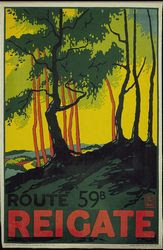
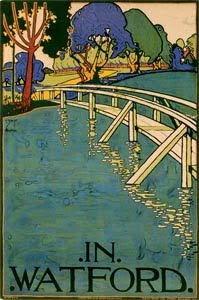
The Edward Kauffer exhibition focused primarily on his transport posters. With his London Transport-commissioned posters, Kauffer idealised mundane, identikit suburban towns. Reminiscent of Van Gogh's depiction of natural landscapes (see previous post), the artist disregarded correct proportions and perspective in favour of creating vivid scenes that captured the imagination of rail travellers.


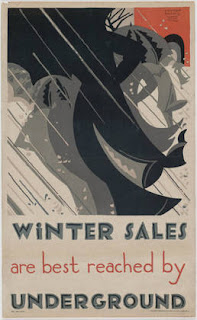
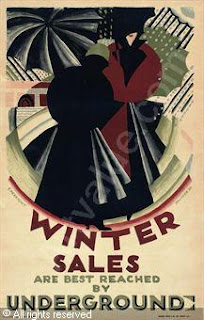
Of all Kauffer's works on display, the Winter Sales London Underground posters were my firm favourites. For these he took inspiration from the fleeting Vorticist movement of his time, cleverly layering geometric shapes to form pictures with real impact.


London Underground is somewhat famed for its artistic sensitivities; the design of the Underground map itself prioritises style (although ultimately, usability) over geographical accuracy, and the roundel logo has become iconic worldwide. Tube trains now exhibit poetry as well as ads; tiled images decorating stations are not uncommon. I hope this tradition of Underground art continues, with future Kauffers gracing our tunnels and adding some colour to what is otherwise a rather grey commuter underworld.

Saturday, 24 September 2011

One Weekend in Amsterdam...

I'm ashamed that it has taken me over three weeks to write up my three-day sojourn in Amsterdam, but as they say, better late than never.

I've been to Amsterdam a few times before, but I was too young to appreciate it properly. It is an absolutely lovely city, lined with attractive three/ four-storey townhouses and inhabited by people almost as tall - or so it seemed to me from my 5ft 1in point of view. Although lethal when on their bikes (everyone cycles in Amsterdam), the Dutch people I encountered were without exception kind and helpful to us.

The first day was uncharacteristically warm for the Netherlands, so my fellow travellers and I decided to make the most of the glorious weather. We walked alongside the Bloemenmarkt, home to innumerable tulip bulbs; basked in the sun on a jetty by the canal; and looked over rooftops and church spires from the tower of a church-turned university. We also managed to stumble upon an Auschwitz memorial in Wertheim Park: a set of broken mirrors distorting the reflection of the sky, to symbolise how what lies above us has been irreparably changed by the horrific events of the Holocaust.


We started the second day with a visit to the world-famous Anne Frank Museum, and followed up this sombre event with pancakes (as you do). The impact of the museum hit me later on as I traversed the city, aware that this was a luxury not afforded the Frank family and other Jews living in the Netherlands in the 1940s.


My post-lunch solitary stroll allowed me to really take in the feel of
the city. Just to walk parallel to the endless rows of manicured townhouses and become lost in thought, was to me a highlight of the trip. When the afternoon rain made an abrupt appearance, I took cover in a church being used as an exhibition space for a wildly varied collection of designer wedding dresses.


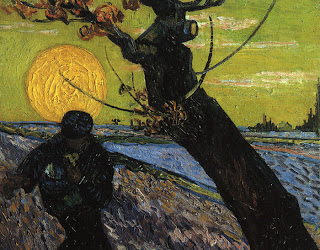
After an amusing-yet-harrowing evening in the Red Light District, off to the Van Gogh Museum we went for a wholly different, but equally surreal experience . Having only really been exposed to his famous sunflowers, it was a pleasant surprise to see that there was so much more to Van Gogh than his better-known still life paintings, including his series of early paintings idealising the peasant lifestyle and a number of works inspired by Japanese prints. I will leave you with my favourites from the museum, chosen because I'm so fond of the vibrant and surrealist colour palette used to craft them.


The Sower

Flowering plum trees (after Hiroshige)

The Garden of St. Paul's Hospital

Monday, 25 July 2011

Watch Me Move

For a slice of on-screen nostalgia, I strongly recommend a visit to Watch Me Move:The Animation Show at the Barbican Centre. The exhibition showcases short films and clips from feature lengths spanning the history of film, and ranging from family-friendly familiars to the experimental, to the downright disturbing!

The numerous screens and projections are the prime focus in the minimal space. Some of my highlights:


The Serpentine Dance (1899) - The Lumière Brothers
This short is one of the first films ever made. It was shot in black and white, and then hand-coloured frame by frame to create beautiful colour transitions that complement the fluidity of the dancer's graceful movements, injecting vibrancy and spirit into the dance.


Duck Amuck (1950s)
In this cartoon, the ill-humoured Daffy Duck is mocked by his creator, who humiliates the character by sketching unfortunate situations for him and threatening his very existence with the rubber on the end of his pencil. These actions provoke the most indignant squawks you are ever likely to hear from a duck. In the closing scene, the shot pans out to reveal that it is none other than Bugs Bunny who is responsible for Daffy's suffering.


Le Nez (The Nose) (1963) - Alexander Alexeieff and Claire Parker
This film by husband and wife team Alexeieff and Parker is based on Russian writer Nikolai Gogol's tale of a young man who loses his nose. The story of the desperate search and the need to conceal the missing facial protrusion is not quite as impressive as the animation itself; the directors used a black canvas full of pins and pushed these in to greater and lesser degrees to create changing shades of grey.


Dimensions of Dialogue (1982) - Jan Svankmajer
I'd unknowingly watched one of Svankmajer's films before seeing Dimensions of Dialogue, as a good friend of mine presented me with Little Otik a few years back. This feature-length film is based on a Czech fairy tale about a tree trunk carved into the form of a baby and adopted by a family, who then struggle with the creature's insatiable appetite for human beings. Clearly, this director has a penchant for the bizarre, and Dimensions is no exception. This short film is very clever in its portrayal of two-person interaction, and beautiful in its own way. On this note, I feel I can only do it justice by describing it in more depth.

The film begins with the confrontation of two heads: one crafted out of vegetables and one constructed from kitchenware. One devours the other and vomits out a hybrid of the two; this demented rock-paper-scissors-esque sequence continues until two bald human heads remain.

In the second 'dialogue', a man and woman made out of clay become intertwined and melded together in a passionate embrace. A clay sex scene ensues, in which they become one indistinguishable entity but for the odd fleeting emergence of a face, hand or other body part. After the figures have separated again, a small lump of clay appears between them. The clay baby is rejected by both and prompts them to become increasingly angry, to the point that they begin to claw chunks out of each other's faces!

The final scene shows two heads engaging with one another through the medium of everyday objects. They start with complementary pairs, such as a pencil and pencil sharpener, or a toothbrush and toothpaste. Yet before long, the heads fall out of accord and the toothbrush is met by the sharpener, the pencil by the toothpaste, etc. The tension climaxes with the implosion of the two.

****

Watch Me Move has reaffirmed my belief that animation is not just, or even chiefly, for kids. The relatively boundless creativity for which it allows is great for expressing adult subject material as well as 'Disney emotions' (which, looking back, aren't all that child-specific in the first place - the witch in Snow White frightens me today as much as she did when I was four). So pop along to the Barbican Centre to sample the wonderful world of animation, which seems to err between the surreal and something much closer to home.

Saturday, 11 June 2011

Out of this World

This is the second time I’ve been to an exhibition at the British Library (the first time being last summer when I stumbled upon Magnificent Maps), and fortunately I was as impressed as I was first time round. Out of This World showcases an array of books that represent the science fiction genre of literature. I hope to familiarise myself better with the genre; a number of books from the exhibition have made my reading list since my visit.

The antecedents of science fiction date back much further than you might expect. Voltaire’s Micromégas (1752), for example, recounts an extra-terrestrial man's visit to Earth and comments on western culture from the perspective of the outsider. However, the genre only really took off a century later. The popularity of science fiction literature grew in tandem with the advent of a great age of discovery; in the late nineteenth century to early twentieth century, archaeological finds such as the tombs of Egypt’s Valley of the Kings fascinated the public and thus inspired a ‘Lost World’ sub-genre to form. Scientific intrigue was prolific during this period, giving birth not only to notions of different life on Earth, but also life on Mars, hence the rise of a 'Martian' sub-genre. Real-life political and social events were also integral to the development of science fiction.; case in point: the ‘Superhero’ sub-genre was influenced by Nietzsche’s Ubermensch. History also features in science fiction literature: counter-factual novels speculated on what would have happened if Hitler had won WWII, if Napoleon had won the Battle of Waterloo, etc.

A collection of science fiction novels on display focus on the future, looking into how mankind would be affected if current developments were to continue or increase in intensity. The prophetic Man after Man: An Anthropology of the Future by Dougal Dixon, for example, imagines the evolution of humans after an era of extensive genetic engineering. Morphed with various creatures, human beings can adapt to survive in environments they currently cannot, e.g. the vacuumorph described in the book can live in the vacuum of space, and the aquamorph can breathe underwater.

Within the section dedicated to the future, 'End of the World' novels dominate. Real-world events such as the development of the nuclear bomb and climate change awareness informed these novels, with authors using them to weave apocalyptic yarns. Of particular note is Earthdoom, a satiric novel that mocks this sub-genre.

Overall, Out of this World is cleverly and thoughtfully put together. It challenges the unfavourable stereotype of science fiction perpetuated by 1950s B-movies, with little green men and frisbee spaceships, and highlights the scientific, historical, political and cultural influences prevalent in this oft-bashed genre.

Wednesday, 8 June 2011

Condensed London

A couple of weeks ago, I whiled away a drizzly bank holiday Monday in the Museum of London. The museum encapsulates seven major time periods, allowing visitors to journey along the city's extensive lifeline. It illustrates the evolution of the small Roman town of Londinium into the heaving, sprawling London of today.

As I progressed through the eras, what struck me was how much London has endured; from the the Great Fire and the Black Death to the Blitz of WWII, the city has been dealt more than its fair share of adversity. London as a centre of culture and high civilisation, the economic heartbeat of the country, the hub for imperialist endeavors, etc. - this image of the city as a 'success story' is generally impressed upon us more than one of a city afflicted by death and devastation. I'm glad that the MoL does not assign more weight to the former image (and I always enjoy the more gruesome bits of history!).

The museum does not miss a beat: it includes archaeological findings, animated disaster stories, paraphernalia from social movements and wartime, mock Victorian shops and much more. A day is definitely needed to explore all the galleries... and perhaps a second visit.