Showing posts with label Saatchi Gallery. Show all posts

Monday, 13 September 2010

300 Speakers, 26 Letters and other Oddities

Currently showing at the Saatchi Gallery, Newspeak: British Art Now celebrates the creative offerings of a new generation of young British artists. The collection seeks to defy the Orwellian brainchild "Newspeak" - a universal language whose vocabulary shrinks with every passing year - by showing that a multitude of visual languages are being exploited in contemporary Britain. Here are some I was drawn to:

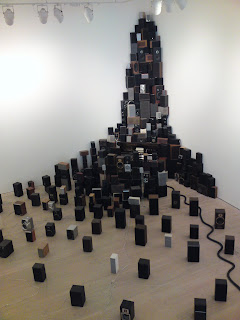
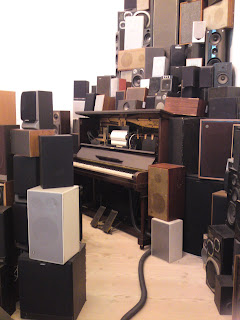
Despite the variety on display, exhibited sound artist John Wynne highlights issues of endangerment, obsolescence and extinction. His untitled installation of 300 speakers, a player piano and a vacuum cleaner plays with these notions, as modern digital technology distributes sound through the old speakers rescued from a recycling plant. The resulting "music" is eerie - a slow-paced, perpetual, nostalgic noise pollution of sorts. In the past, Wynne has produced installations focused specifically on the subject of endangered languages, such as Hearing Voices, based on "click languages" spoken by the indigenous Khoi and San inhabitants of the Kalahari Desert.

Below is detail from She Gets Even Happier, a collage crafted by the scissors and pen of Clunie Reid. By scrawling the words "I Shop in Iceland" over British Spears's face, she is mocking the cult of celebrity and the media overload that propels it. She is like Warhol-in-reverse, taking icons and making them ordinary, bringing the likes of Britney crashing down to earth from the great heights of glossy stardom.


Ged Quinn's Dreams Of Peace And Love Gradually Giving Way is based on Claude's Landscape with the Arrival of Aeneas at Pallanteum from Anglesey Abbey. The artist specialises in paintings that include contemporary images in idyllic scenes copied from classical paintings. In this particular piece, part of Aenea's ship has been recycled into a miniature cinema showing Little Tinker, and another part is carrying the Discovery from Stanley Kubrick's science fiction film 2001: A Space Odyssey.


A Joan Crawford Alphabet is typical of Donald Urquhart's work, which tends to indulge in the dark side of of Hollywood glamour in a somewhat simplistic and light-hearted way. This artwork is miles away from the 26-letter wall chart one would find in a school classroom; does Urquhart smash childhood innocence, or is he merely injecting some playfulness into his depiction of Crawford's life?


Tuesday, 16 March 2010

The Empire Strikes Back

The Saatchi Gallery's The Empire Strikes Back: Indian Art Today exhibition was extremely well thought out. Although the exhibition had great variety, it also managed to maintain cohesiveness in the message it sought to convey. Much of the artwork delivered an opinion on the Indian polity, but the majority of pieces provided cultural commentary. The prominent cultural theme was a sense of "otherness", as paintings and sculptures metaphorically screamed out against the "Orientalist" school of thought.


Jitish Kallat's Public Notice 2 recalls the speech delivered by Gandhi on the eve of the Salt March to Dandi in protest against the British-imposed salt tax. The speech, calling for complete yet peaceful civil disobedience, is recreated using 4479 bone-shaped letters made out of fibreglass. Contained in a cavernous room displaying no other works of art, this installaton is commanding and powerful, yet also haunting. The scale and isolated state of the speech do well to emphasise its significance.


From a reasonable distance, Veil I, Veil II and Veil III appear to each show a burqa-cloaked figure. Yet upon closer inspection, you'll see each image consists of thousands of small, unfocused pornographic photos of women. Rashida Rana's art serves to oppose culturally constructed stereotypes of women. He successfully illusrates his disapproval of the sexual objectification of women and the perception of the burqa as a political symbol post-9/11 simultaneously.


Ajit Chauhan's ReRecord consists of 162 erased vinyl album covers. The marketing tool that is the album cover is effectively undermined by his alterations, and familiar portraits are rendered abstract. The artist's way of playing with our sense of perception is lighthearted, but certainly effective; it was slightly unsettling confusing Bruce Springstein with Michael Jackson in one particular instance!


The title of Tushar Joag's installation, The Enlightening Army Of The Empire, refers to the bureaucracy, which has provided continuity from British rule through to the post-independence era. The dishevelled robots are connected at the feet by tangled wires, which gives the impression of a disorganised union.


Reena Saini Kallat's Penumbra Passage (Canine Cases) is a series of portraits of Indian and Pakistani civilians. On the face of each is a Kashmir-shaped blemish, and underneath each is a case containing an assortment of weaponry - a lament of the conflict in the region of Kashmir.


The precariously balancing chairs of Mansoor Ali's Dance of Democracy symbolise the instability of the Indian political system. Moreover, the fact that the structure appears to stay upright due to luck alone is telling of the artist's feelings about democracy in India.