Wednesday, 10 November 2010

When London Met Autumn

In London, the changing of the seasons is never more apparent than in one of its green spaces. Battersea Park, a mere stone's throw from where I work, is where I first fully appreciated that summer had slipped away, and that autumn had arrived with its auburn blush and its crisp air. It was during one of my occasional lunchtime strolls. My iPod and surroundings were effective means of escapism on that particular day; the computer desk, plastered with post-it notes reminding me of all the things left to do before 5, seemed very far away. I remember my only concern being that I didn't have gloves - and I wasn't really bothered. Maybe the aesthetic beauty of autumn is consolation for loss of body heat; there's something quite magical about seeing bursts of red amid the greens of the park, enough to distract you from the cold wind gnawing at your ears, nose and fingers.


Tuesday, 19 October 2010

Toys and Taxidermy

What weekend would be complete without a trip to a museum exhibiting deceased woodland creatures, carefully arranged in distinctly human scenarios? Or a miniature fairground populated by kitsch toy characters, which springs to life every fifteen minutes? Or circus posters showcasing the entire spectrum of sideshow freak? The Museum of Everything currently offers all this and more.

Imports from Victorian taxidermist Walter Potter's Museum of Curiosities...


Photos of the circus's circuit regulars...


Arthur Windley's itty-bitty fairground, lovingly constructed over a forty-year period...

Monday, 13 September 2010

300 Speakers, 26 Letters and other Oddities

Currently showing at the Saatchi Gallery, Newspeak: British Art Now celebrates the creative offerings of a new generation of young British artists. The collection seeks to defy the Orwellian brainchild "Newspeak" - a universal language whose vocabulary shrinks with every passing year - by showing that a multitude of visual languages are being exploited in contemporary Britain. Here are some I was drawn to:

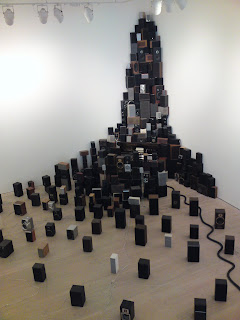
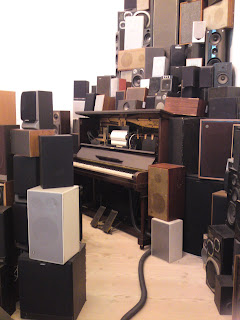
Despite the variety on display, exhibited sound artist John Wynne highlights issues of endangerment, obsolescence and extinction. His untitled installation of 300 speakers, a player piano and a vacuum cleaner plays with these notions, as modern digital technology distributes sound through the old speakers rescued from a recycling plant. The resulting "music" is eerie - a slow-paced, perpetual, nostalgic noise pollution of sorts. In the past, Wynne has produced installations focused specifically on the subject of endangered languages, such as Hearing Voices, based on "click languages" spoken by the indigenous Khoi and San inhabitants of the Kalahari Desert.


Below is detail from She Gets Even Happier, a collage crafted by the scissors and pen of Clunie Reid. By scrawling the words "I Shop in Iceland" over British Spears's face, she is mocking the cult of celebrity and the media overload that propels it. She is like Warhol-in-reverse, taking icons and making them ordinary, bringing the likes of Britney crashing down to earth from the great heights of glossy stardom.


Ged Quinn's Dreams Of Peace And Love Gradually Giving Way is based on Claude's Landscape with the Arrival of Aeneas at Pallanteum from Anglesey Abbey. The artist specialises in paintings that include contemporary images in idyllic scenes copied from classical paintings. In this particular piece, part of Aenea's ship has been recycled into a miniature cinema showing Little Tinker, and another part is carrying the Discovery from Stanley Kubrick's science fiction film 2001: A Space Odyssey.


A Joan Crawford Alphabet is typical of Donald Urquhart's work, which tends to indulge in the dark side of of Hollywood glamour in a somewhat simplistic and light-hearted way. This artwork is miles away from the 26-letter wall chart one would find in a school classroom; does Urquhart smash childhood innocence, or is he merely injecting some playfulness into his depiction of Crawford's life?


Thursday, 2 September 2010

Magnificent Maps

Due to some builder-related technical fault, the phones and internet at my work were down, so I was allowed to leave the office at 3pm. This left me with over four hours until I was due to meet friends for a meal in Covent Garden, so how did I choose to fill my time? I walked from Golders Green to the restaurant - a valiant effort, considering it was 6.5 miles in shoes that pinch! (My toes are still a little deformed from the trek.) One of my rest-stops was the British Library because I'd heard about its current exhibition, Magnificent Maps: Power, Propaganda and Art, and I happen to be weirdly interested in cartography (if you didn't think I was cool already...).

When you look at a map, you have to think beyond the science of longitude and latitude. Maps are hugely subjective; they don't just fulfil a geographical purpose. For example, they've often been used for self-aggrandisement by national leaders, who seek to impress upon others their status as ruler over a "great" land. Imperial rulers would demand that their conquests be signified on official maps; kings of relatively small countries tried to compensate for size by insisting national cultural and scientific achievements be emphasised by cartographers. Maps have also been used as pieces of political satire, as propagandist artefacts that tell contemporary audiences a great deal about the geopolitical climate that informed their creation.

Some favourites from the exhibition:

Detail from Stephen Walter's The Island, which satirises the London-centric view held by people in the capital. Commuter towns are shown as independent from the city, which appears to be its own country. Note the intricate detail in the second picture.


Dimitri Moor's Be On Guard! shows a heroic Soviet soldier warding off bourgeois threats to the then infant USSR.


Macdonald Gill's Tea Revives the World (1940) is my personal favourite. The message is that tea, and by extension the Allied war effort, can cure a sick world. The map is unashamedly imperialistic in its proud demonstration of Britain's economic and colonial dominance. I guess Gill didn't anticipate the decline of the British Empire in the post-war period.


Confiance was made in Vichy France to demonise Churchill as a land-grabbing octopus, whose tentacles needed to be severed by the Axis powers. The octopus motif is a pretty common one; it was first used in cartography to show the imperialist threat posed by the Russians in the late nineteenth century.


If you're at all interested, some satirical WWI maps can be found here.

Wednesday, 18 August 2010

Prison Portraits and the Art of Torture in Pol Pot's Cambodia

This blog post is inspired by the fact that I've just finished reading Philip Short's Pol Pot: The History of a Nightmare. For those of you who don't know, in 1975 the Khmer Rouge (a.k.a. the Communist Party of Kampuchea) unleashed upon Cambodia what can only be described as a totalitarian nightmare, from which it has yet to fully recover. The country had already been made to suffer immensely as a pawn in the US's Cold War game in Indochina; thousands of B-52 bombing raids brought Cambodia to its knees in the early '70s and rendered its people submissive, dispirited and most importantly, vulnerable to a Khmer Rouge takeover. The Party's attempt at implementing a Khmer-specific, agrarian brand of communism during its four-year period of absolutist rule resulted in the creation of a modern slave state, where the urban masses were forced to evacuate the towns and become part of the peasantry, toiling on the land for little food and no money. Townspeople, and particularly intellectuals, were despised as bourgeois counter-revolutionaries; purges of alleged subversive elements of Cambodian society were commonplace and of such a magnitude that, teamed with the later purges among party ranks, they arguably constituted a genocide (though the word "genocide" doesn't really accurately describe the Cambodian experience, as the Khmers Rouges never intended to exterminate; they set out to enslave rather than kill). The total death toll is disputed, but it is generally agreed that roughly a fifth of the population died during the period of Khmer Rouge control.

In view of the uncompromising nature of the Khmer Rouge regime, it will come as no surprise to learn that it made extensive use of prisons, and of torture methods within these institutions. The security prison Tuol Sleng, or S-21, was the epicentre of Khmer Rouge brutality. Philip Short aptly describes it as "the pinnacle, the distillation, the reflection in concentrated form of the slave state which Pol had created." Formerly a school (I find the change from place of learning to house of pain to be fairly emblematic of the degradation of Cambodia during this period, and also of the regime's assault on reason and logic), S-21 was where at least 14 000 people were tortured to death or sent to killing fields. Only seven inmates were known to have survived, even though its prime purpose was to extract confessions rather than to kill. Philip Short argues that this particular torture centre was different to others, in that it fitted neatly into Khmer society; it wasn't an aberration, but rather a reflection of how the savage ways of ancient times lingered in Cambodia.

There's some really interesting art out there documenting the horrors of S-21. Take, for example, the portraits of Nhem En. He was the chief of six photographers employed by the prison to take pictures of the new inmates as they first entered. Their faces hang in rows on the walls of Tuol Sleng, which is now a genocide museum. Imagine standing in the room populated by hundreds of these portraits, each face conveying through its fixed gaze a haunting combination of trepidation and despair.


One of the faces photographed by Nhem En belongs to Vann Nath, an artist, and one of the seven survivors of S-21. It was in fact his skill that saved him from the grisly fate met by other prisoners of the secret prison, for he was put to work painting official portraits of Pol Pot. Incredibly, Nath chose to return to the place after his escape, to work at the museum it had become. Rather than try to forget the horrors of his past, he dedicated his life and his talent to exposing the horrific acts committed by the Khmer Rouge. Vann Nath witnessed some of the most severe crimes against humanity in history; his paintings serve as a crucial reminder of past suffering, and as a powerful call for vigilance against such suffering in present and future times of crisis.


Sunday, 15 August 2010

June '10 - Bye Library, Hello Outside World

This year, the end of exam period was greeted by a rare spell of sunshine. Usually, London is only glorious weather-wise when I'm trapped in a library. The great urban outdoors beckoned; Super Mario Galaxy and other indoor amusements had to wait.

I actually discovered the Hill Garden and Pergola behind Golders Hill Park on a day of outdoor "revision", which consisted of Machiavelli's I Discorsi being on my person but never quite opened. I returned a few weeks later and enjoyed a much more guilt-free wander there after visiting Kenwood House. It's a tranquil spot made for those who love the Hampstead Heath area, but want to escape the hype of activity typical of Parliament Hill or Golders Hill Park on a hot summer's day.

Another decent discovery I made post-exams was Room 46a of the V&A, which houses plaster casts of grandiose European sculptures. These stairs in my future home, please.

To top off a culturally-enriching week of London walks and museum visits, I was lucky enough to catch the Elephant Parade herd at the Royal Hospital Chelsea. The individually-designed elephants, previously scattered around the capital, had been herded together for a few days only; after which time they were sold at auction to raise money for the Elephant Family (cue conversation: "But please, I've always wanted one and I promise I'll take good care of it!"). My personal favourites included Fish and Chips Elephant, Mr Clegg, Taxi Elephant and Elephant in the City. I wonder what your choice of elephant reveals about your personality...


Tales of more recent excursions/thoughts to come very soon. Many things have happened since June, one of them being July... and half of August... FAIL.

Tuesday, 16 March 2010

The Empire Strikes Back

The Saatchi Gallery's The Empire Strikes Back: Indian Art Today exhibition was extremely well thought out. Although the exhibition had great variety, it also managed to maintain cohesiveness in the message it sought to convey. Much of the artwork delivered an opinion on the Indian polity, but the majority of pieces provided cultural commentary. The prominent cultural theme was a sense of "otherness", as paintings and sculptures metaphorically screamed out against the "Orientalist" school of thought.


Jitish Kallat's Public Notice 2 recalls the speech delivered by Gandhi on the eve of the Salt March to Dandi in protest against the British-imposed salt tax. The speech, calling for complete yet peaceful civil disobedience, is recreated using 4479 bone-shaped letters made out of fibreglass. Contained in a cavernous room displaying no other works of art, this installaton is commanding and powerful, yet also haunting. The scale and isolated state of the speech do well to emphasise its significance.


From a reasonable distance, Veil I, Veil II and Veil III appear to each show a burqa-cloaked figure. Yet upon closer inspection, you'll see each image consists of thousands of small, unfocused pornographic photos of women. Rashida Rana's art serves to oppose culturally constructed stereotypes of women. He successfully illusrates his disapproval of the sexual objectification of women and the perception of the burqa as a political symbol post-9/11 simultaneously.


Ajit Chauhan's ReRecord consists of 162 erased vinyl album covers. The marketing tool that is the album cover is effectively undermined by his alterations, and familiar portraits are rendered abstract. The artist's way of playing with our sense of perception is lighthearted, but certainly effective; it was slightly unsettling confusing Bruce Springstein with Michael Jackson in one particular instance!


The title of Tushar Joag's installation, The Enlightening Army Of The Empire, refers to the bureaucracy, which has provided continuity from British rule through to the post-independence era. The dishevelled robots are connected at the feet by tangled wires, which gives the impression of a disorganised union.


Reena Saini Kallat's Penumbra Passage (Canine Cases) is a series of portraits of Indian and Pakistani civilians. On the face of each is a Kashmir-shaped blemish, and underneath each is a case containing an assortment of weaponry - a lament of the conflict in the region of Kashmir.


The precariously balancing chairs of Mansoor Ali's Dance of Democracy symbolise the instability of the Indian political system. Moreover, the fact that the structure appears to stay upright due to luck alone is telling of the artist's feelings about democracy in India.